


How to Prepare for a Trade Show to Generate Results After the Event
Participating in a trade show represents a significant investment. In addition to the space, there are costs associated with the booth, travel, staff, promotional materials, and marketing.
However, the real return on a trade show rarely comes during the event itself. Most business opportunities arise in the weeks that follow, through follow-up with the contacts made.
Por este motivo, una presencia eficaz debe planificarse desde el principio con un objetivo claro: convertir a los visitantes en oportunidades comerciales reales.
1. Set specific goals before the trade show
Before you begin designing the booth or creating marketing materials, it’s important to understand what the company hopes to achieve.
Objectives may include:
- generating requests for quotes;
- introducing a new product;
- scheduling demonstrations;
- finding distributors or partners;
- boosting brand awareness;
- re-engaging former customers;
- collecting qualified leads.
Objectives such as “raising the company’s profile” are too vague. Whenever possible, they should be transformed into measurable goals.
For example:
- collect 100 qualified leads;
- schedule 20 demonstrations;
- obtain 15 requests for quotes;
- schedule meetings with five potential partners.
These objectives will influence the booth design, the sales approach, and the follow-up process.
2. Create a stand designed to attract and convert visitors
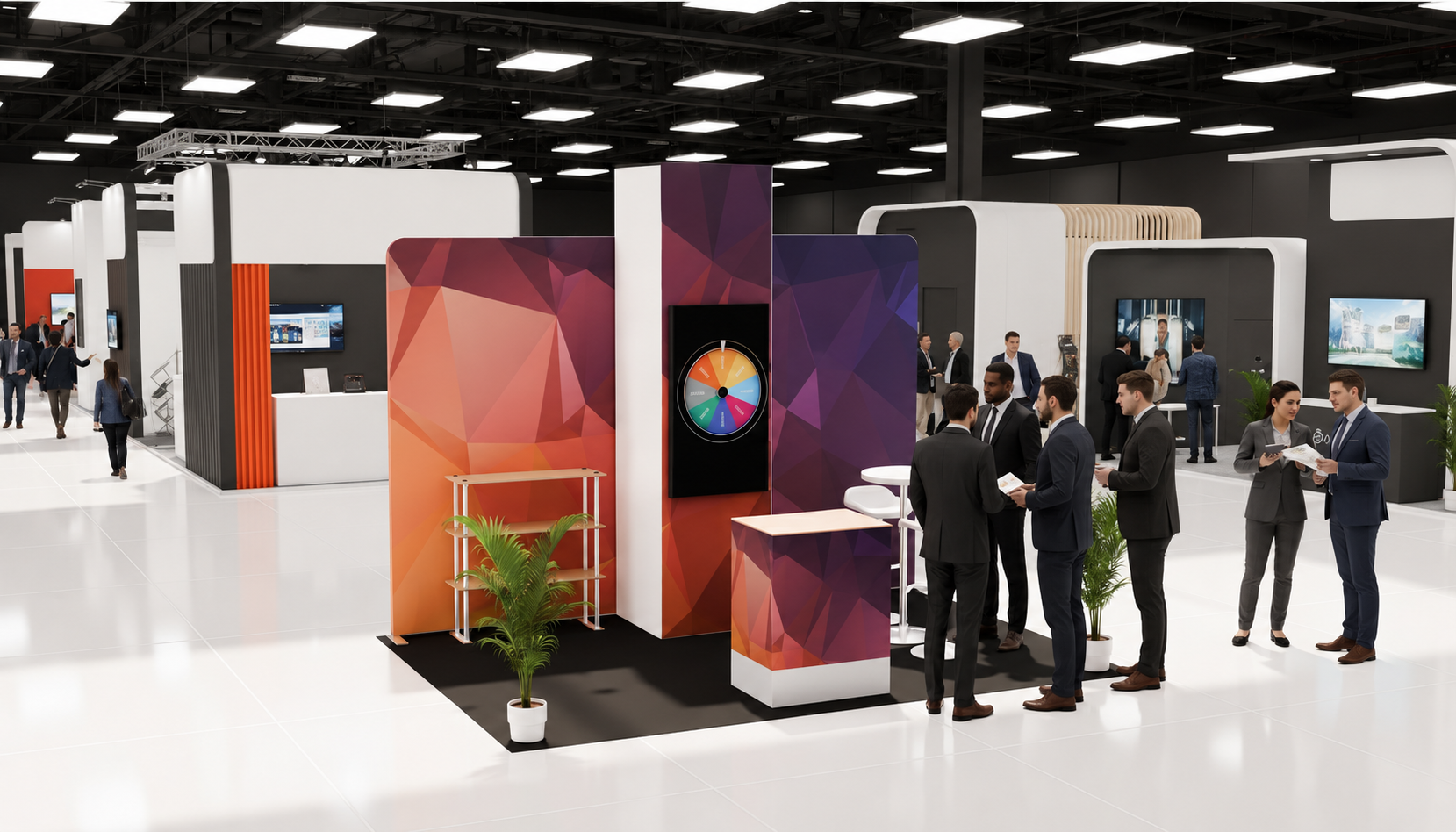
A booth shouldn’t just be used to showcase the brand. It should facilitate interaction between the team and visitors.
The layout of the space should allow visitors to quickly understand:
- who the company is; what it offers;
- what its main advantage is;
- what they should do next.
Too much information can make the space confusing. In many cases, a clear and highly visible message produces better results than several small, hard-to-read texts.
The booth should also include areas suited to the objectives of the event, such as:
- a demonstration area;
- a meeting space; a reception desk;
- a product display area;
- screens with digital content;
- a lead-generation system.
The structure should complement the experience the company aims to create, rather than serving merely as a decorative element.
3. Communicate a clear value proposition
Visitors to a trade show are exposed to dozens or even hundreds of companies. The main message must be understood in just a few seconds.
Instead of simply presenting a list of services, you should highlight the problem the company solves or the benefit it offers.
Compare these two messages:
- “We develop technology solutions for businesses.”
- “Reduce logistics management time through a centralized platform.”
The second version is more specific and gives visitors a concrete reason to start a conversation.
This value proposition should be featured in the booth’s graphics, promotional materials, and the team’s pitch.
4. Give visitors a reason to interact
A visually appealing booth can attract attention, but it doesn’t guarantee engagement.
To encourage visitors to approach, you can include:
- live demonstrations;
- interactive experiences; simulators;
- contests; content customization;
- short presentations; photo opportunities;
- brand-related giveaways.
The experience should be tied to the product or service being showcased. An activity may generate many leads, but it will be of little use if it attracts people with no commercial interest in the company.
The goal isn’t just to increase the number of visitors. It’s to start meaningful conversations.
5. Prepare the team to qualify leads
The team manning the booth plays a decisive role in the trade show’s outcome. Before the event, they should be familiar with:
- the objectives of participating;
- the brand’s key messages;
- the priority products or services;
- the qualification questions;
- the lead-generation process;
- the next steps following each conversation.
Instead of simply collecting a name and email address, it’s important to gather information such as:
- company;
- job title;
- need;
- timeline;
- available budget;
- product of interest;
- contact priority;
- agreed-upon next steps.
This information allows you to personalize your follow-up and increases the likelihood of conversion
6. Simplify the process of collecting contact information
Business cards are still used, but they can get lost or be taken out of context.
Whenever possible, there should be a simple, centralized system for recording contacts during the trade show.
You can use:
- digital forms;
- QR code scanning;
- event-specific apps;
- CRM integration;
- tablets at the booth;
- specific landing pages;
- business card scanning tools.
The most important thing is to ensure that all contacts are recorded in the same place and include notes about the conversation.
A contact without context makes follow-up slower and less effective.
7. Prepare the follow-up before the event
One of the most common mistakes is to start thinking about follow-up only after the trade show. By then, the team has returned to their regular work, tasks have piled up, and several days have passed before they contact the visitors.
The process should be prepared in advance. Before the trade show, define:
- who will be responsible for each contact;
- when the initial outreach will take place;
- what emails will be sent;
- how contacts will be categorized;
- what information will be added to the CRM;
- when a call will be made;
- what the next steps will be.
You can also prepare different messages for each type of visitor.
For example:
- request for a quote;
- interest in a demo;
- potential partner;
- contact with no immediate need;
- current customer;
- former customer.
The more personalized the follow-up, the higher the likelihood of a response.
8. Make initial contact quickly
The first follow-up should take place while the company and the conversation are still fresh in the visitor’s mind. Ideally, the follow-up should begin within the first few business days after the trade show.
The message should reference the context of the conversation and outline a clear next step. For example: “It was a pleasure to welcome you to our booth during the trade show. As we discussed, I’m sending additional information about the solution we presented. Can we schedule a brief meeting to discuss how it could be applied at your company?”
Avoid generic, mass-sent emails that make no reference to the interaction that took place.
The visitor should understand that the message stems from a specific conversation and not just from being added to a database.
9. Establish a follow-up process
A single email is rarely enough.
Follow-up can include several steps:
- a thank-you email;
- sending information or a proposal;
- a sales call;
- sharing a case study;
- an invitation to a meeting or demo;
- reaching out again after a few days;
- including the lead in a relevant email campaign.
The frequency should be balanced. The goal is to keep the opportunity active without creating excessive pressure.
Leads with no immediate need can also be followed up over time with useful content, news, completed projects, or invitations to future events.
10. Measure engagement metrics
The success of a trade show should not be judged solely by the number of visitors to the booth.
At the end of the process, analyze metrics such as:
- number of leads collected;
- qualified leads;
- scheduled meetings;
- requests for quotes;
- proposals sent; sales made;
- total value of opportunities;
- cost per lead;
- conversion rate;
- return on investment.
This analysis helps you understand what worked and improve your participation in future events.
It also helps identify whether the issue lay in attracting visitors, lead qualification, the sales approach, or follow-up after the trade show.
Participation in a trade show doesn't end when the event ends
An effective booth should capture attention, facilitate conversations, and lay the groundwork for future business.
However, the return on investment depends above all on preparation, the quality of the leads gathered, and the speed of follow-up.
At Poster Digital, we develop turnkey sustainable solutions for trade shows and events, from design and 3D modeling to production, transportation, assembly, and disassembly.
We also create reusable structures, fabric graphics, and digital solutions that can be adapted to different campaigns and events.
By managing the entire process in-house, we help brands create a cohesive, functional, and results-oriented presence.
Are you planning your company’s participation in a trade show? Contact us to develop a solution tailored to your goals, the available space, and the experience you want to create.